
Practice Loving the Doing
Someone told me that the work most worth doing is often the biggest pain in the ass.

Less than week until we are partying, in the flesh. On Green Street. In North Brooklyn. Good old Greenpoint. Join us. RSVP here. Bring a friend.
What pulls you out of your cozy bed in the winter? Why do you put on pants to leave the house? A few basic things like food, hot liquids, and my 9-to-5 get me there. But in 2026, fighting the urge to stay inside and doomscroll requires defined purpose. For me, I’m trying to build a community of artists and makers that do hard things and I want to connect with them in person.
Supporting artists and their projects often means showing up, physically. Which is why I attended a screening this week of an old friend’s first feature film, Love, New York. I did the thing, even while bearing the sweaty aftermath of too much Valentine’s Day red wine.
I share this story to inspire. Artists both have solutions for how to live life and they also have a unique experience of doing almost exclusively hard things, making sometimes marvelous things where previously there existed nothing.
After the lights came up in the theatre the audience clapped and whooped. The director came on stage, flanked on either side by a total of 10 cast members and the newly minted Commissioner of the Mayor’s Office of Media and Entertainment, Rafael Espinal for an informal Q&A.
During the Q&A, my friend, the director Anthony DiMieri bragged that 50 new SAG memberships were created on this production. Love, New York starred a massive ensemble cast with nearly 60 speaking roles and over 100 actors on screen. When he was asked what he did on this film that he definitely would not do on a future production, he quipped: “We don’t have time for that!”
He went on to say that the sheer number of scenes, actors, and locations was hard to manage for an indie production. Instead of shooting over days or weeks they shot all summer.
“Coordinating schedules can be crazy. Next time, I would find a block of time and get everyone to commit [to the schedule] up front. We are doing this and this, over these days.”
The Creative Producer on the project, Kayla Dawn Marcus, chimed in that the production felt “dangerously bold” when compared to the film set on which she had met DiMieri, the indie production, Two, which featured just one location.
Another actor on the Q&A panel, Ezra Barns, who featured as a widower in an awkward scene of budding romance with a paid escort, cut in and stopped everyone short.
“I fundamentally disagree with everything that has been said.”
Barns explained that the ambition of this film is what makes it magic. Connecting all of these scenes, fragments of love stories drew on the energy of New York City to create something that felt alive. The premise could have failed terrifically, instead the magnitude, the complexity brought out the vibrancy of the city. He described New York as a beautiful scene partner. Truthfully, I couldn’t transcribe what he said word for word. But what I heard was: you need to try to do the hard thing instead of settling for some pale edit of your vision. Trying to make your vision a reality, that’s the magic.
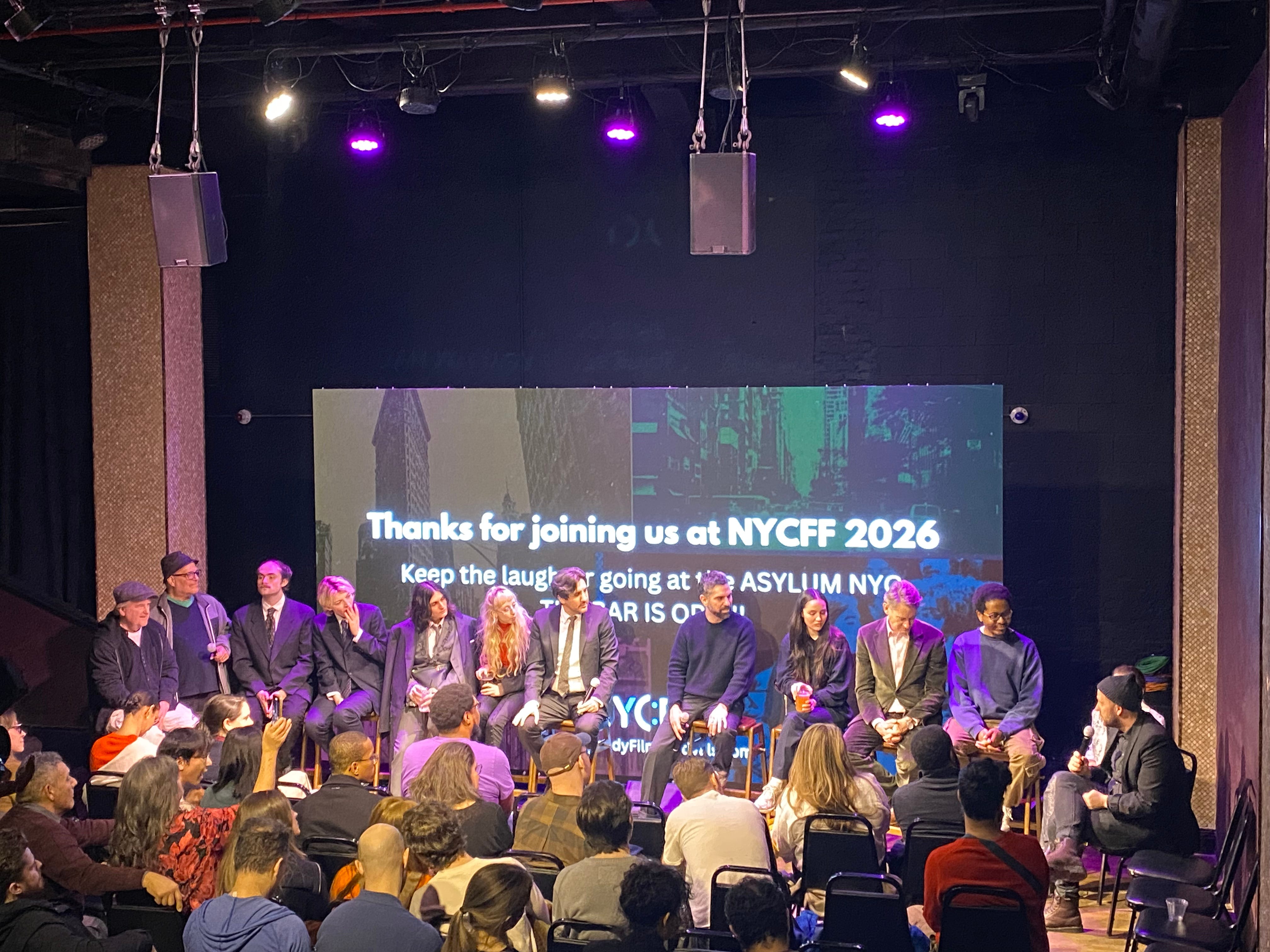
The big message in his film, according to the director, Anthony DiMieri: “That book from the park dancing scene, The Art of Loving, by Erich Fromm, it’s pretty good. You should all read it.”
From Fromm:
The first step to take is to become aware that love is an art, just as living is an art; if we want to learn how to love we must proceed in the same way we have to proceed if we want to learn any other art, say music, painting, carpentry, or the art of medicine or engineering. What are the necessary steps in learning any art? The process of learning an art can be divided conveniently into two parts: one, the mastery of the theory; the other, the mastery of the practice. If I want to learn the art of medicine, I must first know the facts about the human body, and about various diseases. When I have all this theoretical knowledge, I am by no means competent in the art of medicine. I shall become a master in this art only after a great deal of practice, until eventually the results of my theoretical knowledge and the results of my practice are blended into one — my intuition, the essence of the mastery of any art. But, aside from learning the theory and practice, there is a third factor necessary to becoming a master in any art — the mastery of the art must be a matter of ultimate concern; there must be nothing else in the world more important than the art. This holds true for music, for medicine, for carpentry — and for love.
Until next week!
Pass this to a friend. Keep the magic alive.
Feel free to reach out via email: info@mindground.app.